 Light
Lift and crest
Val Gardena top stations
- Feet
- Boots with grip
- Pack
- Water, layer, sun
- Extra
- Lift ticket
Guides
Language
EnglishCurrency
US dollar · $GetYourGuide uses the currency you choose.
Guide · Gear
Dolomites hiking gear does not need to be expensive, but it needs to be right: boots that grip on limestone, layers for a crest that is far colder than the valley, and a few small items the rescue services ask for.
Editorial team, hikingdolomitesitaly.comUpdated October 25, 20266 min read25 sources
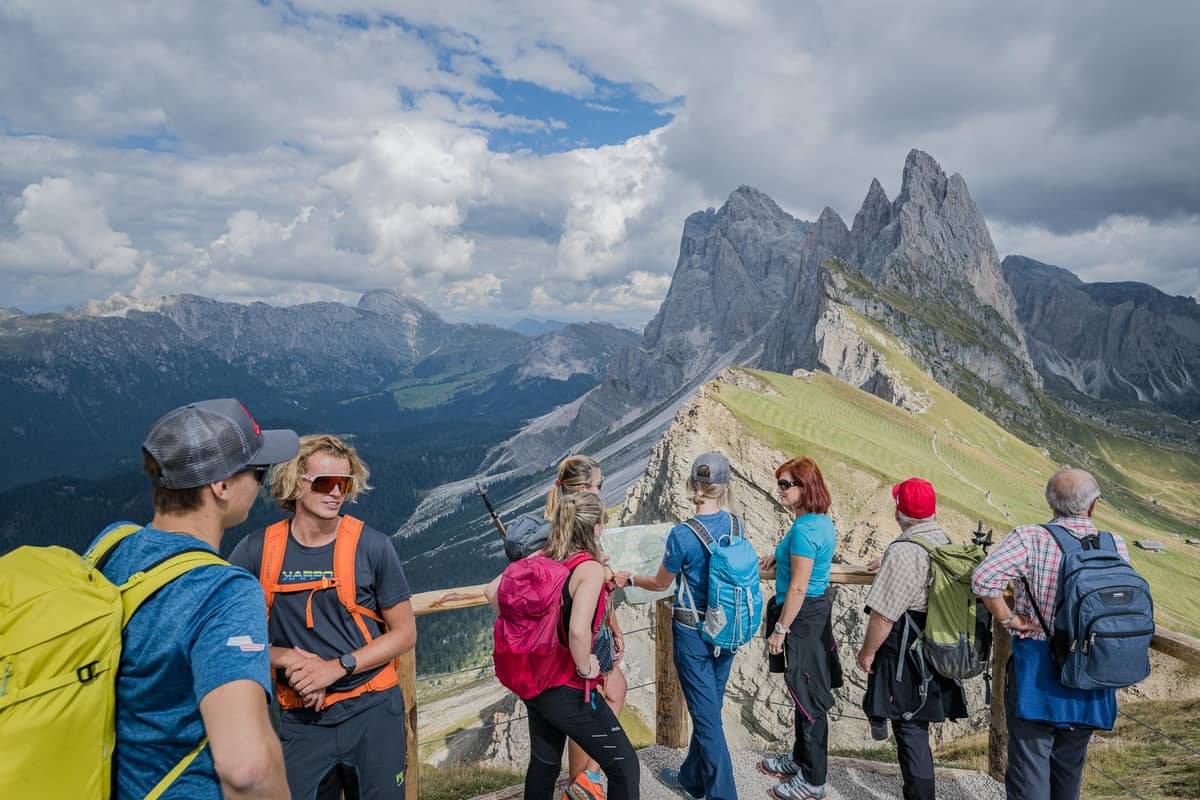
You do not need to guess what to bring, because the people who rescue hikers have written it down. Trentino's mountain rescue, together with the UNESCO Dolomites Foundation, the SAT huts and the alpine guides, publishes a handbook of 10 rules, and its gear rule is short: for trekking you must have technical boots, a water bottle, a rain jacket, food, a headlamp battery, spare parts and a first-aid kit.42
Val Gardena tourism gives the same advice for its high crests: hiking boots with good grip, a backpack with provisions and clothing for possible weather changes.1 Both lists are about safety first and comfort second. A long day in the Dolomites can start in sunshine at a lift station and end in cold rain on a crest, and what is in your pack decides how that goes.
The guided day from Molveno adds its own list: sunglasses, a sun hat, snacks, sunscreen, water and trekking gear. The listing also notes that its 6.5-hour hike needs a moderate level of fitness, which is the other piece of equipment you bring with you. Everything below builds on these lists.
Footwear matters most, because Dolomite trails are rough. Much of the walking is on limestone: scree, slabs, stony paths and loose gravel below the walls. The UNESCO description of the range stresses its highly varied limestone formations, and your soles will feel every one of them.5 Choose hiking boots for the Dolomites with a firm, deeply lugged sole that grips on dry rock and does not skate on wet stone.
Ankle height is a personal choice. Low trail shoes are fine on the Alpe di Siusi meadows or the lower Brenta huts, where the path from Pradel to Croz dell'Altissimo is graded T, the easiest level.6 For long descents on scree, like the climbs to the Tosa and Pedrotti huts or the Forcella de Mesdì, a boot with ankle support and a stiffer sole saves your feet and your knees.78
Whatever you choose, wear it in at home. New boots on a 5.5-hour circuit like the Sassolungo are an invitation to blisters.9 Bring the socks you will hike in when you buy, test the fit going downhill, and carry blister plasters in the first-aid kit anyway.
Why layers matter
The list
| Item | Why | When |
|---|---|---|
| Boots with grip | Rough, stony limestone | Always15 |
| Rain jacket | Rain on 13 or 14 days a month | June and July10 |
| Warm layer | Lows of 4.8°C in September | Always10 |
| Headlamp | On the rescue service's list | Always2 |
| Food and water | Huts may be shut | Off season11 |
| Via ferrata set & helmet | Required on via ferratas | Climbing days only12 |
From Trentino's mountain rescue handbook, Val Gardena tourism and the Selva di Val Gardena station normals.2110
Decision helper
Match the footwear to the walk you plan
Rolling paths at 1,800 to 2,500 m, mostly farm tracks.14
Pradel to Croz dell'Altissimo is graded T, the easiest level.6
4.5 hours from Molveno up the Val delle Seghe.7
One of the most demanding passes in the Dolomites.8
And a helmet; via ferratas are for experienced mountaineers.12
If you go trekking, you must have technical boots, water bottle, rain jacket, food, a headlight battery, any spare parts and a first-aid kit.
The mountains are colder than the valley, and even the valley is cool. At the official station in Selva di Val Gardena the average July high is 20.2°C and the low 8.2°C; in September the high is 14.6°C and the low 4.8°C.10 On a crest some hundreds of meters higher, in wind, it feels much colder than that.
Dress in layers you can add and remove: a thin synthetic or merino top next to the skin, a fleece or light padded jacket over it, and a waterproof shell on the outside. Add a warm hat and light gloves for early and late season, when October lows in Selva average 1.2°C.10 Hiking trousers that dry fast beat jeans, which stay cold and heavy once wet.
Rain is part of summer here. The Selva station records 14 rainy days in an average June and 13 in July.10 A breathable rain jacket that packs small is the single most useful item after boots, and a cover for your backpack keeps your spare layer and phone dry.
Checklist
Video
The video starts loading once you tap play.
Altitude sharpens the sun. On the open crests and plateaus there is little shade, and the reflection from pale limestone adds to it. Sunglasses, a sun hat and sunscreen are on the guided tour's list for a reason, and they belong on yours. Reapply sunscreen at lunch; the cool air hides how strong the sun is.
Carry water from the start. Huts are frequent in the busy areas, with 18 in the Seceda and Col Raiser area alone, but outside the main season they may be closed, so water and food belong in your pack every day.1611 On long stretches of open rock, like the Sassolungo circuit, there is little chance to refill.
Food is easy to plan around the huts in summer, and part of the pleasure of a Dolomite day. Still pack snacks that survive a squashed backpack: nuts, dried fruit, a sandwich. The guided day from Molveno lists snacks and water and does not include lunch, which you buy at the refuges along the way.
Your phone is a safety tool. The emergency number is 112, and the official Where Are U app can call it with a single tap and send your exact position to the rescuers.3 Install it before you leave home and keep the phone charged; a small power bank weighs little and lasts a day of map use and photos.
Do not rely on the phone alone for navigation. Trentino's rescue service asks you to follow the numbered signs and the white and red trail marks and to carry a map, paper or digital.13 Download the route so it works without signal, and carry a paper map as backup for the days when the battery or the network fails.
A headlamp battery is on the official list even for day hikes, because a late start or a slow descent can leave you on the trail at dusk.2 Add a basic first-aid kit with blister care, pain relief and an emergency blanket. Know that helicopter rescue is not free in Val Gardena; an annual Aiut Alpin membership costs $45 per person.17
Walking poles earn their weight on the long descents that most Dolomite walks end with. Coming down 1,200 m from Seceda to Ortisei on foot, or down the Val delle Seghe from the Brenta huts, they take load off your knees and help on loose gravel.187 Choose folding poles that fit inside your pack for the lift rides and the bus.
Light gloves and a warm hat weigh almost nothing and make a big difference on a windy crest or an early start in September, when the average low in Selva is 4.8°C.10 A buff or neck gaiter doubles as sun protection at midday. A small dry bag inside your pack keeps your phone, documents and spare layer dry in a downpour.
Finally, bring some cash. Many mountain huts are small family businesses, and a few coins and notes are useful for coffee, lunch or the paid turnstile on trail 6 at Seceda, which costs $6.19 With that, your pack is ready for almost any summer day in the range.
Leave the camping gear at home if you are thinking of a night out on Seceda: wild camping and overnight stays in tents are strictly prohibited there, and so are drones.2021 The huts are the place to sleep in the mountains. Leave cotton at home too, and anything heavy you will not use.
Via ferratas are a different matter altogether. They are intended only for experienced mountaineers equipped with a via ferrata set and a helmet, and routes like the Bocchette Centrali in the Brenta are graded EEA.1222 If you have never used that kit, hire a local mountain guide rather than learning on the wall.
No gear replaces judgement. Check the local forecast, tell someone your route and expected return, and turn back if you get tired, unsure of the way or the weather turns, as the rescue service advises.232425 Good boots and a warm jacket make a bad day bearable; a good decision avoids it.
Your Brenta day
Pick a date, meet at the ticket office, and cancel free if the forecast turns.
Hiking boots with good grip. Val Gardena tourism asks for boots with good grip; Trentino's rescue service lists technical boots.12
Yes, a rain jacket. June averages 14 rainy days and July 13 at the Selva station, and the rescue list includes a rain jacket.102
Cool, especially up high. In Selva the average September high is 14.6°C and the low 4.8°C; crests are colder.10
It is on the official list. Trentino's mountain rescue lists a headlamp battery among the essentials for any trek.2
Where Are U. It calls 112 with one tap and sends your exact location to the rescue team.3
No. Wild camping and tents are strictly prohibited on Seceda; sleep in a hut instead.20
Yes, a set and a helmet. Via ferratas are only for experienced mountaineers with a via ferrata set and a helmet.12
Sources
Keep reading